Annabel Romero Hernandez
Portfolio MFA Visual Arts Clark U - January 2026
I am an interdisciplinary, research-based artist rooted in Mexican plant and food traditions. My projects emerge from Mexico’s landscapes, markets, and kitchens, and from the pre-Hispanic food knowledge I grew up with as a living inheritance. I was trained to see structure as a map, as evidence that becomes knowledge through interpretation. In the studio, I work with documents, scientific images, recipes, and observation as a living archive. Through print, drawing, embroidery, and paper construction, I build tactile artist books that function like maps, inventing a personal visual language to trace relations across scientific and embodied knowledge.
I’m drawn to cartography as a way of thinking, a form that shapes what counts as knowledge. I’m pushing maps beyond their political weight and into tools to organize living knowledge, tools that help us understand life across scales, from microscopic structure to everyday practice. I start from lived experience, family memory, place, and daily practice, and use that ground to push larger questions about how maps make knowledge.
PENCAGRAFÍA
Accordion book
Pencagrafía is an accordion book composed of smoke-toned and olive-green pages that echo the color of a burned agave penca. At the center of each fold, small abstract drawings emerge from microscope images of agave leaves. Cellular structures are translated into topographic forms, transforming microscopic observation into a shifting landscape. The book format presents the maguey as both a biological body and a landscape.
LA PARCELA DE TOÑO
Sculptural artist book
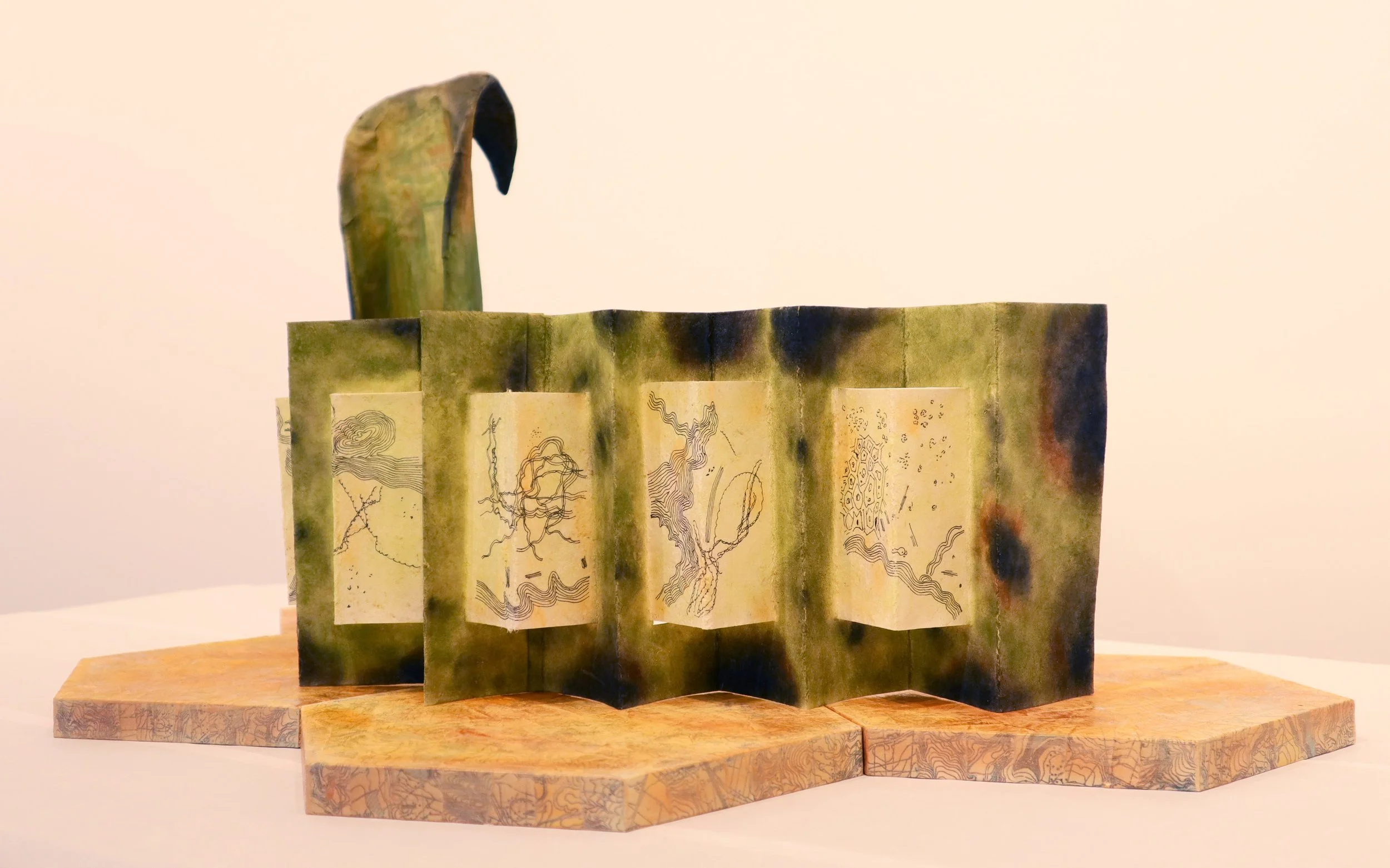
La parcela de Toño is a sculptural artist’s book that, when displayed, takes the form of a barbacoa pit. The book contains drawings of the topography of a parcel of land granted through Mexico’s “Reforma Agraria” to the artist’s father, Toño, alongside abstracted patterns derived from agave leaves and references to barbacoa. Minimal text appears only in fragments, allowing the work to function as a material record of land, labor, and family ritual. The piece connects territory, plant, and cooking as intertwined systems of memory and care.
IXTLE
Embroidery on ayate
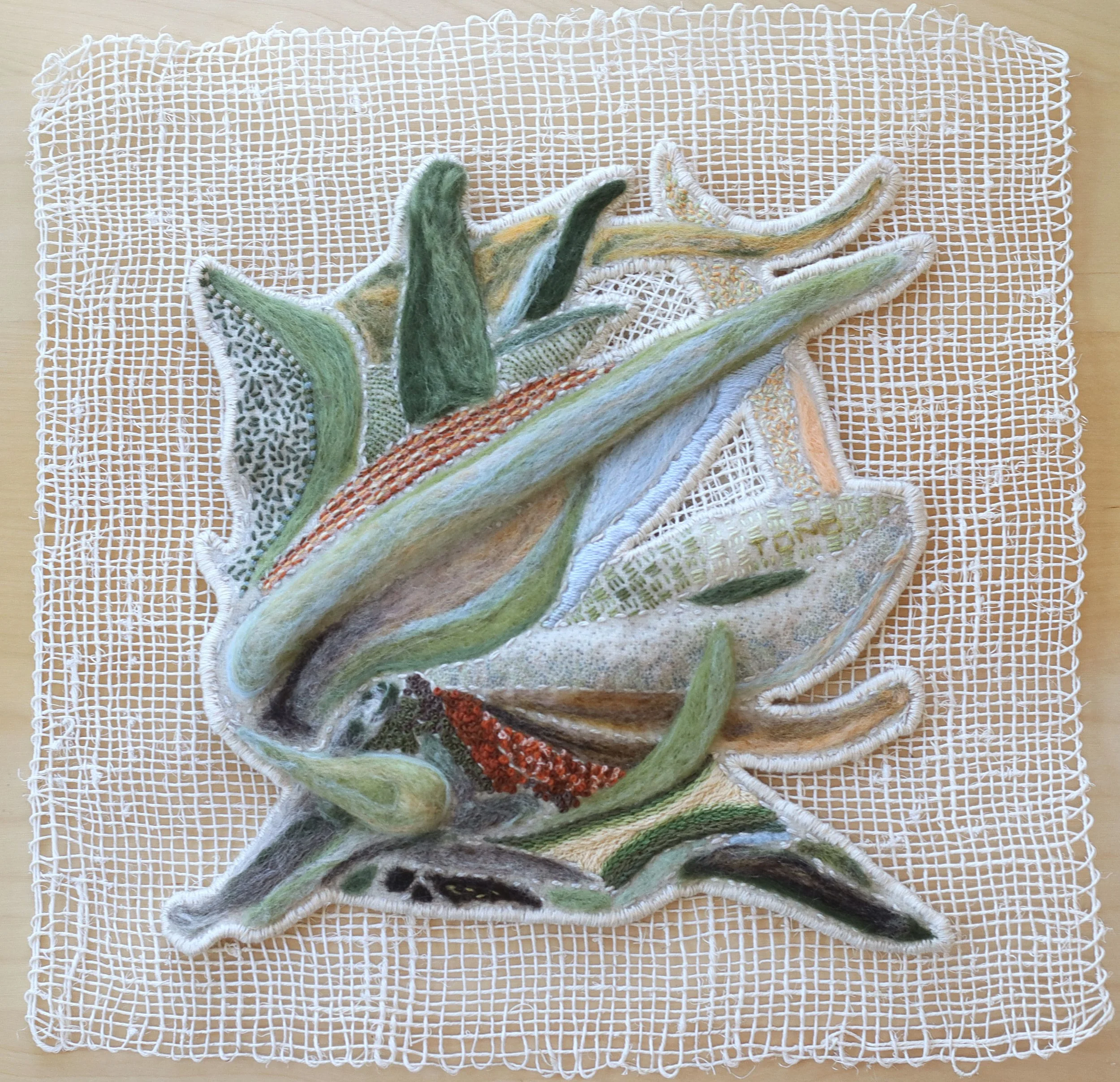
Ixtle approaches the maguey as a structure of relations. The interwoven leaves suggest how a plant stores information through overlap and tension, an ecology made visible in form. Using thread, needle-felted wool, and ixtle on an ayate, the work builds a dense, tactile surface that represents a landscape: layers and pathways you navigate by touch.
MIURA DEL MAGUEY
Folded paper work
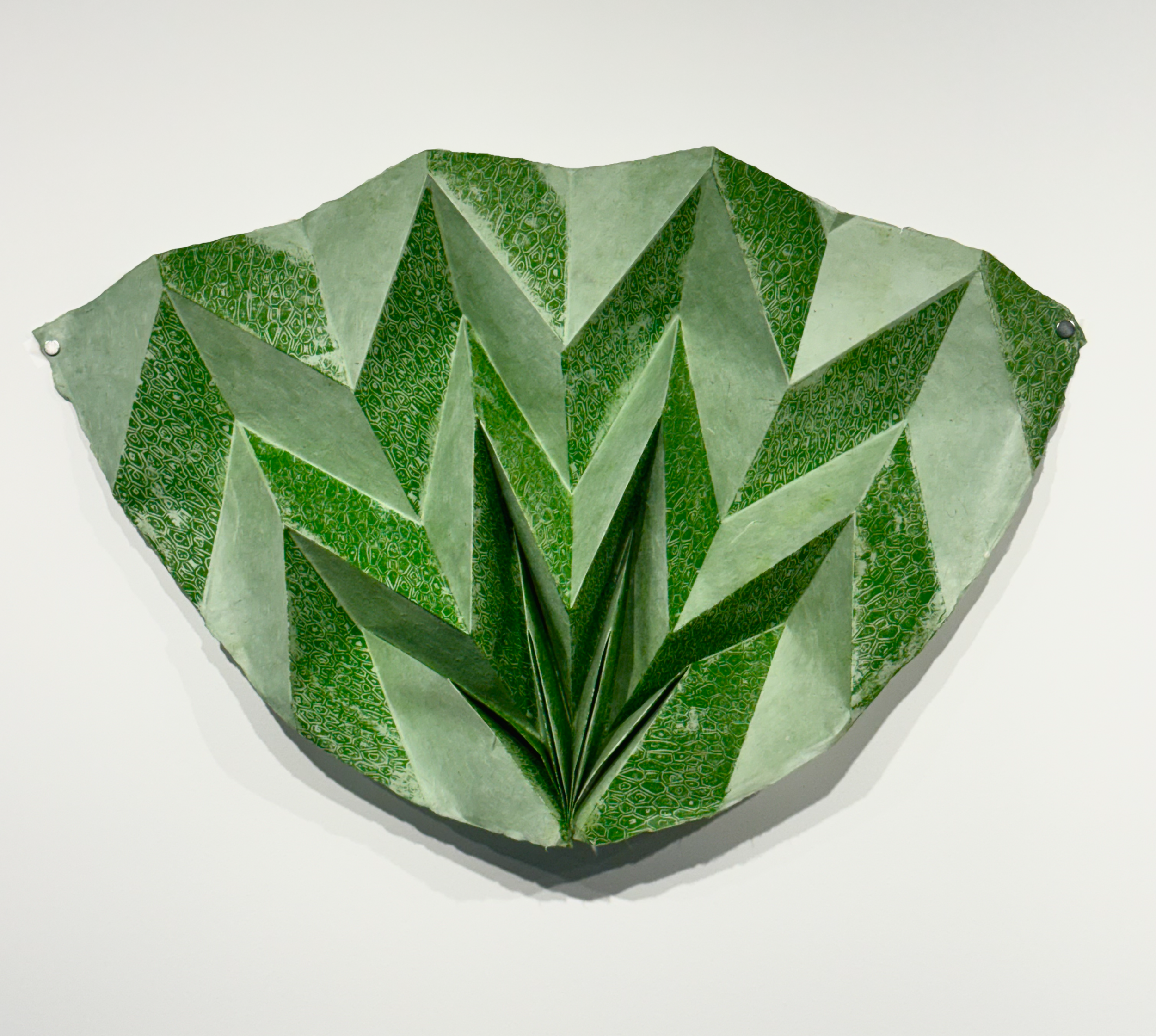
Miura del maguey is a wall-mounted work composed of multiple Miura-ori folds arranged in a fan-like formation, evoking the rosette shape of the maguey plant. The surface combines drawn topographies with representations of agave cellular structures, merging the scales of landscape and leaf anatomy. The fold aligns with the plant's organic growth, allowing the maguey to appear simultaneously as structure, pattern, and living system.